
Lord Krishna
We have the best instructors
“Sambhava:mi yuge yuge” – I shall incarnate in this world in every Yuga (millennium)
Divya Saketham is one such manifestation of the statement made by Lord Krishna. Technically speaking Divya Saketham is a temple, but if we have a look at the history of its making one would be able to understand the essence as to why this ordinary looking “temple” got the name “Divya Saketham”.
To begin with, Divya Saketham has three floors, where three different avatar of lord vishnu reside in the form of deities. The first floor of Divya Saketham has the main deity in the form of Lord Rama (Kondandaramaswamy), who beautifully dwells along with His retinue –Vishwakse:na, A:lwa:rs, Acharyas and others. The very sight of the deity reminds one of the grace, love and affection which Lord Rama had in his heart, for his parents, and in turn filling our hearts with those same virtues.
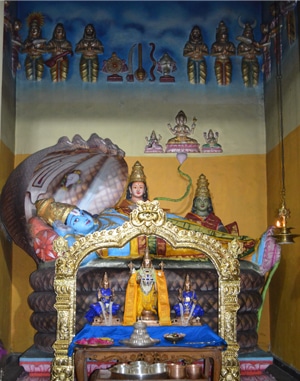
If one goes to the second floor, one would get to witness the whole of universe in one sight. This floor has the original form of the Lord, lord Ranganatha along with his consorts Lakshmi and Goda. Lord Brahma is also depicted here, praying to lord Ranganatha here, and it is through His prayers here, the lord protects the living entities of the world. The divine-body of Lord Sri Ranganatha is color, constituted with sa:lagra:ma:s that have been acquired in worship from all the Divyadesams. Worshipping Lord Ranganatha, in Divya Saketham, is equivalent to worshipping the God in all Divyadesams.
In the third and the last floor, the almighty dwells in the form of Lord Vaikunthanatha, who came down on earth as Vyu:ha, who in turn happens to be the incarnation of Lord Ranganatha. This avatar of the Lord carries out the task of creation, sustenance, and destruction. From this Vyu:ha Lord Ranganatha, the Lord further came down as human incarnation of Sri Sitha Ramachandra Prabhu who is the presiding, primary deity of Divyasa:ke:thamtemple. At the top of these altars, there is the sanctum-tower called Sri Vima:nam which has taken the shape of eight-structured-tower. The dazzling divine discus Sri Sudarshanam is installed on top of the primary tower. Beneath this there are eight other towers. Each of the eight towers is embellished / consecrated with one syllable from the Narayana Ashtakshari, Manthram and the presiding deities regularly accept our propitiations.
A similar type of eight-tower sanctum is found only in one other known asGoshtipuram in South India. This also happens to be the first Divyade:sam sung by the A:lwarsand also the place where the great Sri Ramanujacharya – the preceptor of Visishtadvaithaphilosophy and also a great social reformer, climbed the temple tower and proclaimed the essence of the Narayana Ashtakshari to all interested devotees irrespective of caste, creed and gender.
Circumambulating the pra:ka:ram or the sanctum-walls of Divyasaketam once, is equivalent to directly circumambulating all the 108 Divyadesams. There are 108 altars (each dedicated to the presiding deity of each Divyadesam) in the sanctum-enclosure. These altars have been consecrated by the sacred Tulasiplant procured from 106Divyadesams. And hence, circumambulating the pra:ka:ram is equivalent to directly worshipping all the 108 Divyadesams.

Divya Saketham History

His Holiness Sri Sri Sri Pedda Jeeyar Swami , for the benefit of mankind, Graced us with the 3 basic tenets of
- SriVaishnavism
- Tatthvahitapurusharttha – the absolute truth
- The final goal – Achieve the final goal
Commemorating 100th birth anniversary of Pedda Jeeyar Swami , HH Chinnajeeyar swamiji dedicated Divya Saketham three stare temple to his Acharya.
The BhumiPuja and SankusthapanaPuja (groundbreaking ceremony), for Sri KodandaRama, Sri Ranganatha, and Sri Vaikunthanatha temples was performed during the 2006 Chaturmasya by His Holiness Sri Sri Sri Tridandi Chinna Srimannarayana Ramanuja Jeeyar Swami.
The installation of deities in Divya Saketham temple was conducted by His Holiness HH Chinna Jeeyar Swami from April 29 to May 10, of 2009 in a glorious manner.
Consecration Program Details
Date |
Program of the day |
Pratishta Ceremony |
Ishti |
|---|---|---|---|
| Apr 20 | —————- |
Purvanga of pratishta of all three deities – this included vishwaksena aradhana and punyahavachanam followed by bhadrapitha bandhanam in the place of kurmam and other yantras, according to sripancharatra agama. |
—————- |
| Apr 27 | —————- |
Balakumbhasthapana and Ankurarpanam |
—————- |
| Apr 28 | —————- |
Vastupuja, vastuhomam and vastubali |
—————- |
| Apr 29 | Bhagavad Ramanuja’s Thirunakshatram |
Aranimathanam. Chayadhivasam and Panchakalasasnapanam |
—————- |
| Apr 30 |
ashtottharam of Sri PeddaJeeyar Swami was performed. Sri PeddaJeeyar swami’s picture was given to thousands of devotees by His Holiness ChinnaJeeyar Swami. Sri ChinnaJeeyar Swami explained that Sri PeddaJeeyar Swami 70 years ago established, how to perform mass pujas without difference to caste, creed, age and sex in accordance with sasthras. |
sapthadasa (17) kalasakarmaangasnapanam, Lajadhivasam, Netronmilanam and sayyadhivasam |
Sudarshana Ishti was performed |
| May 1 |
Samuhika upanayanam was conducted for free including free food and accommodation. His Holiness HH Chinna Jeeyar Swami gave Bramhmopadesam for 320 vatus. 3000 people attended the event on behalf of these 320 vatus. Following which, about 500 people were given samasrayanam. On this day samuhika Godadevi puja was also performed. |
Bimbayantrasthapana, stapanam, tatthvanyasam, and homams |
Vaibhaveshti was performed on May 1, 2009 to satisfy Pitrudevatas. This is also called Vaishnaveshti. |
| May 2 |
Ashtottara puja was performed to Lord Venkateswara. Shodasa (16) kalasa pots snapanam and chatushthanarchana were performed to the temple deities |
Shodasa (16) kalasa pots snapanam and chatushthanarchana were performed to the temple deities |
Vainateyeshti was performed on May 2nd on Aslesha Nakshathram and Saturday for good children.. |
| May 3 |
Sri Rama Ashtottharam was performed in the morning. prathishta (installation) ceremonies included Ekavimsati (21) kalasastapanam, chatuhshanarchana |
Ekavimsati (21) kalasastapanam, chatuhshanarchana. |
Sri Lakshminarayaneshti was performed to remove the poverty of all bhagavad bandhus. |
| May 4 |
Samuhika Sri Krishna puja |
Pancha vimsasti (25) kalasastapanam was performed |
Sri Hayagriveshti was performed for knowledge. |
| May 5 |
Ekadasi Day. Sri Narasimha puja was performed. |
Ekonapanchasath (49) Kalasastapanam and chatursthanarchana was performed to the deities. |
Parameshti was performed. |
| May 6 |
AshtottaraSatanama puja was done to Sri Ranganatha |
—————- | Vishwakseneshti was performed for success and destruction of enemies. |
| May 8 |
Ashtotthara Satanama puja was performed to Sri Lakshmi. |
—————- |
Sri Vasudeveshti, Sri Nrusimheshti were performed. |
| May 9 |
Samuhika Sudarsana Ashtottara, Satanama pujas were performed. |
—————- |
Sri Vaiyuhikeshti was performed on May 9. With the ultimate goal of “sarvejanasukhinobhavantu”. |
The pranapratishta of Lord Sri Kodandarama, Lord Sri Ranganatha and Lord Sri Vaikuntanatha was done on May 7 2009 in a grand ceremony.
Vahana Seva
May 7 Pushpa Pallakki
May 8 Hanumantha Vahanam
May 9 Lord Sri Kodandarama – Garuda Vahanam
Mother Sita HamsaVahanam
Divya Saketham Architecture
- Agama – Pancharathra
- Vimanam – Ashtanga
- Area – 5232 sq. ft
- Total temple Height – 97ft tall
- Rajagopuram is about 77ft and 18 ft wide. There are 7 Kalasas on the Gopuram.
- Dwajasthambham is coated with brass film
- 3 tiered
- Sri Kodanda Rama on the first tier
- Sri Ranganattha in the second tier
- Sri Vaikunttanattha in the third tier
On the periphery wall of this temple figures of deities of all divyadesams are embossed. Mud obtained from the 108 divyadesams were placed under respective deity.